The 12 Days of Christmas — Snark Edition
Posted: December 27, 2013 Filed under: Christmas, Church Humor 3 Comments My least favorite Christmas carol by far is the “Twelve Days of Christmas.” It’s not that I wouldn’t want to give my “true love” a whole bunch of poultry, its that it’s the Yuletide equivalent of “99 Bottles of Beer on the Wall.”
A couple of years ago I wrote a blog post titled The 12 Days of Christmas (The “Real” True Meaning). It was rather church humor-y in nature as I imagined the meaning behind the twelve gifts (ie. Six Geese a-Laying — six seminarians laying homiletical eggs in the pulpit).
Anyway, this year I’m offering the official Clergy Family Confidential snark version of the 12 Days of Christmas. Enjoy and Merry Christmastide!
Twelve drummers drumming until your ears start to bleed and please get rid of that Little Drummer Boy while you’re at it.
Eleven Pipers piping “Amazing Grace” since that’s all they seem to know
Ten Lords-a-Leaping which is heretical since there’s only one Lord.
Nine Ladies liturgically dancing in outfits made of pink chiffon so you’ll want to avert your eyes.
Eight Maids-a-Milking but don’t drink the milk because it’s neither pasteurized nor homogenized so there are chunks floating in it.
Seven Swans-a-Swimming in your basement because you forgot to turn the water off and the pipes froze.
Six Geese-a-laying goose poop all over your back yard.
Five Gold Rings or actually just one because you pawned the other four.
Four Calling Birds which are really annoying when they wake you up way too early on New Year’s Day after a late night out.
Three French Hens although you’d much prefer French fries.
Two bars of Dove soap shaped like turtles that you can’t wait to regift.
And a Partridge in a Pear Tree which looks more like a pigeon than anything else.
The Blingiest Angel
Posted: December 23, 2013 Filed under: Christmas, Church Humor Leave a comment Inspired by an angel at our recent “Little Kids” Pageant following church on the Fourth Sunday of Advent, I wrote a new Christmas story. Among the twenty or so angels, one stood out. They were all adorable, of course, and we only had one “fallen angel” this year — she fell off the stage. But one angel refused to wear the requisite white cotta and showed up in a shimmery dress. It was awesome!
So after tinkering with sermons and liturgical details all afternoon it just sort of poured forth. Everyone has different ways of dealing with pre-Christmas energy — some eat sugar cookies or drink egg nog. I blog. It’s a horrible piece of “literature” but it was fun to write. Enjoy.
The Blingiest Angel
Six-year-old Angelina loved to play dress up. She didn’t care for costumes like tutus or princess gowns. Angelina was all about the bling. Tiara? Of course. Giant shiny costume jewelry? Naturally. Silver sequins? The best.
When she realized she was finally old enough to play an angel in her church’s Christmas pageant, she  could barely contain her excitement. Throughout the first few weeks of December, she spent every evening rummaging through her mom’s jewelry box to find the perfect combination of Christmas bling. While her mother didn’t own a blingy halo, she was confident this could easily be created.
At the first rehearsal, the pageant director handed out white robes and halos made out of tin foil. “No thanks,” said Angelina. “I have my own.” This earned a confused look but Mrs. Dingo figured the little girl’s older sister must have been an angel in a previous pageant. “That mother probably never returned the robe,” she thought. “One did go missing two years ago.”
That night Angelina, stayed up past her bedtime to put the finishing touches on her costume. She would be the most beautiful and blingiest angel ever to wear wings. Even if no one would really even notice baby Jesus — played by her pest of a baby brother — people who walked in darkness would see a great light.
On Christmas Eve, Angelina spent an hour locked in the bathroom getting ready for the big day. When she arrived, she was resplendent in blinged-out bliss. Her dress shimmered, her halo sparkled, her wings shined. She was the blingiest angel in pageant history.
Her grand entrance didn’t quite go as planned. Mrs. Dingo took one look, pointed her bony finger, and cried, “Out! Out! There was no bling at the manger!” Crestfallen, Angelina left the church and sat sulking and freezing on a stone bench in the church courtyard. She watched as all the C and Eers poured into the small stone church. She felt like Mary and Joseph as they were turned away by the inn keeper, left on the outside looking in.
 But suddenly, just as the procession was about to begin, the cast members, the acolytes, and the clergy were suddenly blinded by a great light. From the courtyard a figure appeared transfigured as a large star rose in the east. Light danced off Angelina’s dress and halo and wings like a vision. Everyone beckoned to her to join the festivities and she slowly walked back toward the front doors of the church.
Angelina’s smile was almost as bright as her bling. Her angelic presence made the pageant come alive. Everyone was thrilled, except for Mrs. Dingo who quit on the spot after serving as pageant director for the last 63 years. The C and Eers were so thrilled they all joined the Altar Guild and starting attending church every week.
In time, Angelina grew up and was called by God to ordained ministry. She is now the blingiest priest in the diocese — literally outshining all the other clergy and even her bishop. Sure, parishioners now must wear sunglasses to church. But through Angelina the light of Christ shines more brightly than ever before.
THE END
9 Words & Phrases Preachers Should Avoid on Christmas Eve
Posted: December 23, 2013 Filed under: Christmas, Church Humor 4 Comments You hear that sound? It’s the click-click-click of Christian preachers throughout the world putting the finishing touches on their Christmas Eve sermons. For many people, this is one of just a handful of times they’ll hear the gospel proclaimed in a given year. Thus there’s an opportunity for preachers to reach many folks who aren’t regular church attendees. The criteria for preachers is simple: welcoming, insightful, funny, moving, relatable, funny, and short. No big deal, right?
I’ve heard preachers use the opportunity to lay thick guilt upon those “C & Eers” — those who only come on Christmas and Easter. One rector I knew stood up at announcement time and said in a very sarcastic voice, “You know, we do this every week.” And I find that attitude so unhelpful. I prefer to err on the side of welcoming and grace. But I’m also aware that no matter how effectively I preach, it’s up to God to move people’s hearts and draw them deeper into the life of the Spirit. That actually takes a lot of pressure off.
Some of the best advice for preachers seeking to knock it out of the park on Christmas Eve comes from the Rev. David Lose. He reminds us that “the Word is proclaimed in the carols, the greens, the candles, and the assembly. You don’t have to say everything.” Amen!
But still, you have to say something. And as you do, here’s some advice on words and phrases to avoid in your Christmas Eve sermon:
Paradigm — No one is impressed with your big fancy words that would be better used in a theological journal. This goes for every sermon, not just the Christmas sermon.
Birthday Party for Jesus — Please don’t trivialize the Incarnation (see below).
Incarnation — Actually this is a great word to use but make sure you define it. You can’t assume everyone knows this theological reference to God entering the world in human form.
Santa — Everybody loves Santa, everybody knows about Santa, but we’re not in church to hear about the jolly old elf.
Keep Christ in Christmas — Uh, that’s what we’re doing in church.
Bands of Cloth — Yes, the New Revised Standard version uses “bands of cloth” rather than the King James’ “swaddling clothes.” All I can think of when I hear this are strips of gauze and mummies. Keep the poetry of our shared story intact.
Greatest Story Ever Told — We know. That’s why we’re here.
Pope — Pope Francis has caused quite a positive stir in his first year as head of the Roman Church. For Anglicans, however, let’s leave our pope envy at the door.
Mashup — We know that the Christmas story used in pageants is an amalgamation of the various gospel accounts. Shepherds and wisemen never show up at the same time and the Magi actually don’t show up for another twelve days. But deconstructing this on Christmas Eve isn’t helpful — go with it and save your textual literalism for an adult education class.
Well, there you go. Blessings to all who prepare and preach Christmas sermons — as well as those who hear them.
Top Ten Ways Duck Dynasty Ruins Christmas — Clergy Edition
Posted: December 21, 2013 Filed under: Christmas, Church Humor 1 Comment As everyone knows, Duck Dynasty’s Phil Robertson found himself in hot water (yes, that’s a cooking reference to boiled duck) after calling homosexuality a sin in a recent GQ article. While many Old Testament prophets had beards, no one I know would confuse Robertson with a prophet or look to him for theological insights.
I’ve actually never seen the show or had even heard of this guy before the controversy erupted (when he flashed on the screen I assumed he was just another member of the Boston Red Sox), this whole situation will have a profound effect on clergy this Christmas. Think I’m being overly dramatic? Here are the Top Ten Ways Duck Dynasty Ruins Christmas — Clergy Edition.
10. Can’t yell “duck!” as the new thurifer wantonly swings the incense pot at a parishioner’s head during Midnight Mass.
9. Guilt over ordering duck sauce with the Chinese meal you’ve had delivered by the only place open on Christmas Eve to cram down between the services.
8. The Verger can’t refer to getting the procession in order as having all his “ducks in a row.”
7. Must take out all references to Make Way for Ducklings during the children’s service. This is a special hardship for clergy in Boston.
6. Forget taking a Duck Boat tour with the in-laws the day after Christmas.
5. Impossible to announce your retirement during Christmas services for fear of someone calling you a “lame duck” on the way out.
4. Can’t sing “Rubber Ducky, You’re the One” while soaking in the tub to relax before all the services start. Plus there are those rumors about Bert and Ernie…
3. Referring to all your parishioners as “sitting ducks” as they sit to listen to the sermon is out the window.
2. Taking side bets on the Oregon Ducks’ bowl game during the passing of the peace is verboten.
1. Forced to remove all all references to foie gras from the Christmas Eve sermon.
So there you have it. Thanks Duck Dynasty guy for making Christmas just a little bit more difficult for all the men and women of the cloth (some of whom may well be considered quacks).
Anyway, I just thank God that I’m not the pastor of Duck United Methodist Church in Duck, North Carolina.
Dog in the Manger: The Pageant
Posted: December 6, 2013 Filed under: Christmas 1 Comment While I’ve been waiting to sell the movie rights to my new book Dog in the Manger: Finding God in Christmas Chaos, neither Stephen Spielberg nor Oliver Stone has called. Nonetheless, I’m delighted that the book has inspired my friend (and Lent Madness Celebrity Blogger) Laurie Brock to write a Christmas pageant.
What I love about her approach to the pageant is that it is truly Incarnational — God is right in the thick of things. And this really gets to the heart of what I was trying to do with the book. Our faith lives are not neat and tidy but messy — true relationship always is. Yet even in the midst of the chaos and muck of the stable, God’s light shines brightly forth. The Light of Christ pierces the darkness of our hearts and touches us in surprising and unexpected ways. Sometimes this even leads to a dog in the manger.
So, if you happen to be in Lexington, Kentucky, on Christmas Eve, I exhort you (a word that’s stronger than “encourage” but weaker than “compel”) to go check out the world premier of The Dog in the Manger pageant at St. Michael’s. And if you’re desperate for a new pageant script have at it (with proper attribution to Laurie and buying an armload of books, of course).
The Dog in the Manger
A Christmas Pageant for St. Michael the Archangel in Lexington, Kentucky, but free to use (with credit) in any parish where a sense of humor and a sense of holy are appreciated and honored.
Characters (in more way than one)
Adults and/or Older Youth
Tom the Pageant Director
Lynne the Over-worked Christian Education Volunteer
The Narrator, who gets Christmas
The Angel Gabriel, whose parents made her/him do this
Joseph, who, yet again, is a bit player in the Nativity Pageant
Children
Marys, several, since all the little girls want to be Mary in the Nativity Pageant
Shepherds and Sheep, traditionally costumed, but only a few. We don’t want to get crazy here.
Ninjas, Nativity lobsters, cows, ghosts and anything else that seems more appropriate at Halloween (because no one ever has enough costumes for the pageant)
A Dog, who sits in the manger (which is pretty much a sturdy box with some creative artwork)
The scene opens with everyone in costume, milling around, doing their own thing. In other words, a typical Christmas Pageant rehearsal. Tom comes in, frantic and excited.
Tom Places, everyone! Places! We have one more rehearsal before the big night. Remember, you are the sermon. You are telling everyone the message of Christmas. It’s all on your shoulders. Let’s get our Christmas on!
Everyone scatters away, frantically.
Tom Okay. Let’s do the whole Annunciation bit. Mary, Gabriel. You’re on.
Joseph wanders on stage, alone, texting, for no real reason. Gabriel is off to the side, looking very bored.
Gabriel shuffles out to the middle of the stage area as the Narrator reads.
Narrator In the sixth month the angel Gabriel was sent by God to a town in Galilee called Nazareth, to a virgin engaged to a man whose name was Joseph, of the house of David. The virgin’s name was Mary. And he came to her and said…
As Aurora reads, several Marys come out, all giggling and twirling in their Mary-ness.
Angel Hey, you’re gonna have a baby (flat, with no emotion)
Tom Cut! Joseph, why are you here?
Gabriel! Where’s the emotion! You’re telling Mary she’s going to have a baby!
Angel That’s what I said.
Tom But you’re GABRIEL!
Angel No. I’m (name of young person). And my parents are making me do this.
Joseph Yours too? And why doesn’t the angel visit Joseph?
Angel He does, in the Gospel of Matthew.
Joseph So why don’t we put that in the play? Joseph never gets to be the star. Always a bridesmaid, never the bride.
Tom Shaking head. And WHY are there so many Marys?
Lynne Well, they all wanted to be Mary, so we really couldn’t say no.
Tom Okay, We’ll work on this later. Let’s move on to the next scene. Places!
 Aurora In those days a decree went out from Emperor Augustus that all the world should be registered. This was the first registration and was taken while Quirinius was governor of Syria. All went to their own towns to be registered. Joseph also went from the town of Nazareth in Galilee to Judea, to the city of David called Bethlehem, because he was descended from the house and family of David. He went to be registered with Mary, to whom he was engaged and who was expecting a child. While they were there, the time came for her to deliver her child. And she gave birth to her firstborn son and wrapped him in bands of cloth, and laid him in a manger, because there was no place for them in the inn.
As Aurora reads, Joseph and the Marys take their place in front of the altar. Joseph is still texting. The Marys are being adorable. The manger appears and one of the kids, dressed like a dog, is sitting in the manger. One of the Marys hands the pup a baby doll. Tom is stressed, but keeps letting Aurora narrate
In that region there were shepherds living in the fields, keeping watch over their flock by night. Then an angel of the Lord stood before them, and the glory of the Lord shone around them, and they were terrified. But the angel said to them,
The surly angel appears
Angel Jesus is born (flat, with no emotion. Tom, however, is quite frustrated.)
And nothing happens – there’s a long silence.
Tom Where are the shepherds?
Lynne Oh, sorry. Shepherds! Sheep! Ninjas!
And an odd assortment of kids wanders into the church as the Narrator reads. They are dressed in all sorts of costumes. They take their places around the Marys and Joseph and the dog in the manger holding Baby Jesus.
Narrator When the angels had left them and gone into heaven, the shepherds said to one another, ‘Let us go now to Bethlehem and see this thing that has taken place, which the Lord has made known to us.’ So they went with haste and found Mary and Joseph, and the child lying in the manger. When they saw this, (narrator keeps reading, and Tom interrupts)
Tom CUT! Why are there ninja shepherds and (whatever other characters are present)?
Lynne We ran out of sheep costumes. Besides, ninjas might have been at the nativity.
Tom The nativity ninja? And why is Baby Jesus in the manger with a dog? Have you all gone crazy? This is a Christmas Pageant! It’s the retelling of the Christmas Story, with sheep and ONE Mary and a happy angel and Joseph, who just gets lost on the way to Bethlehem and doesn’t make hotel reservations. It’s supposed to be pretty and perfect and sweet so parents can take adorable pictures! That is the message of Christmas!
Narrator Actually, it’s not. Christmas is about messy and surprising and unexpected. God was born in a stable, where a dog probably did sleep in the manger and cows ate their dinner and where a young, scared couple gave birth to their firstborn child, baby Jesus. Nothing perfect about that. And those who came to see him were the ones hanging out that night – shepherds, ninjas, outcasts – whoever heard the angels’ invitation and felt joy at being invited. And in the face of baby Jesus, they saw what love looks like.
Love looks like a teenager texting, an angel in a bad mood, and children having fun being in weird costumes. Love looks like our homeless brothers and sisters and those people we call “enemy.” Love looks like our family and friends, even those who, on this night, we miss because they are with God. Love looks courageous and messy and unusual and simple. Love looks like all of us here tonight.
The message of Christmas is pretty simple – long ago, on that night, love came down to be with all of us in Jesus. Love…Love came down at Christmas.
All stand silent for a bit.
Lynne You know, if this were the Charlie Brown Christmas Special, we’d have a song now.
Tom (or a choir member or the choir) sings first verse of Love Came Down at Christmas, congregation is invited to join in on vv 2-3.
Additional directions:
Ad lib. Clearly, perfection is not the key here. And let the dog bark at odd times. It adds to the chaos. Don’t try too hard with the costumes, especially with the teenagers. Except the Marys. They really can’t be too over the top.
The Dog in the Manger, ©The Rev. Laurie M. Brock, 2013 and inspired by The Rev. Tim Schenck and other various clergy who appreciate the beautiful blend of holy and hilarious.
Elf on the What?
Posted: December 3, 2013 Filed under: Advent, Christmas, Church Humor 1 Comment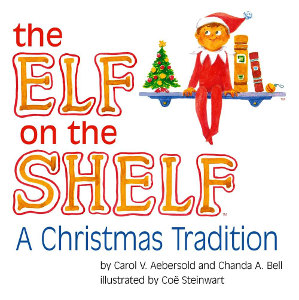 Unless you don’t have young kids at home or simply aren’t interested in all things Christmas, you’ve undoubtedly heard of the “Elf on the Shelf.” While my own kids now aged 14 and 12 missed the whole thing, the phenomenon has exploded the last few years. What is it? According to the website, “The Elf on the Shelf®: A Christmas Tradition is the very special tool that helps Santa know who to put on the Naughty and Nice list.”
In other words, it’s a socially acceptable way to threaten and control your child’s behavior in the days leading up 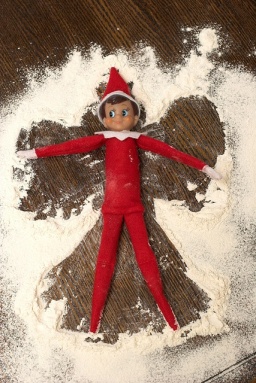 to Christmas. Well, that’s the cynical view. For many it’s a fun, interactive way to build excitement in the days leading up to Christmas. The Elf moves to a different spot in the house every night — creativity is encouraged — and the kids jump out of bed to find him the next morning.
Of course some parents have taken this to the extreme as the website Elf on the Shelf Ideas clearly demonstrates.
There’s also a site dedicated to inappropriate Elf on the Shelf poses that I cannot officially endorse called Oh You Naughty Elf. Click at your own risk.
Perhaps because I never experienced the Elf on the Shelf firsthand, I thought I’d put my lifesavings into a holier variation on the theme. Here’s what I came up with:
Lord on the Ford
The Messiah on the Stolichnaya
Jesus on the Cheeses
The Anointed One on the Hot Dog Bun
Christ on the Ice
The Lamb of God on the Firing Squad
The Good Shepherd on the Leopard
Redeemer on the Beamer
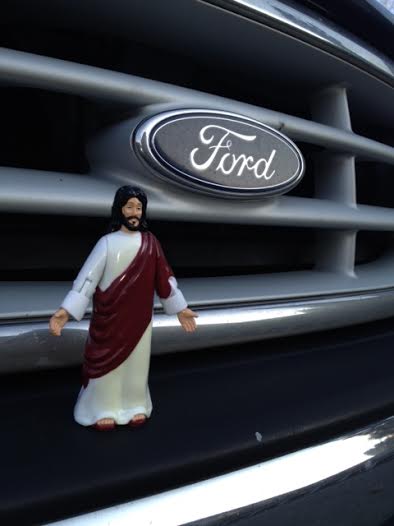 While most of these likely won’t fly, despite my meticulously written business plan and eager investors, I’ve decided to put my efforts into Lord on the Ford. What’s a Christmas tradition that doesn’t include a little corporate sponsorship anyway? I’m convinced that Lord on the Ford, or LOTF, for you texters out there, will be the viral gift of the season.
I personally don’t want anything out of this venture beyond the satisfaction of bringing Jesus more fully into the December mix. Well, that and I’m hoping a 2014 (Christmas) red Ford Mustang will mysteriously appear in the rectory driveway (are you listening NSA and Ford Motor Corporation?!).
Regardless of your approach to Christmas, make sure not to put Jesus on the shelf this Advent. If you have young children at home, enjoy the magic and mystery — it’s gone all too quickly. Or put in a more positive light, it is transformed in new and life-giving ways.
The “Dog” has Landed
Posted: November 4, 2013 Filed under: Advent, Christmas, Writing 1 Comment
While my own copies are “in the mail,” my new book Dog in the Manger: Finding God in Christmas Chaos is now available! Below is the press release which includes a nice quote from my archnemesis, Forward Movement Executive Director Scott Gunn. If the kind words shock you, just imagine him saying them though gritted teeth. I may or may not have said something complimentary in the Acknowledgments section — you’ll just have to buy the book to find out (and that, my friends, is what we call a “teaser”).
If for no other reason, I suggest you pick up a copy for the accompanying cartoons alone. Priest and cartoonist Jay Sidebotham is at his whimsical best, capturing the essence of each essay and conveying the inherent humor — scroll down to see a couple that appear in the book. As I’ve said before, I’m hoping people will buy the book because they think it’s one of Jay’s now famous annual church calendars. A brilliantly diabolical marketing scheme by the folks at Forward Movement!
The book makes a great, cheap ($10) last-minute Advent or Christmas gift. As I think about it, it would be perfect to give to friends and family for St. Nicholas Day on December 6th since it’s the ideal size to jam into a shoe.
Also, for clergy friends, you can use it for a fun, interactive Advent series — there are reflection questions following each section. I’m personally using it as a two-part series on Advent spirituality for parents but it’s appropriate conversation fodder for adults of any age.
Anyway, I do hope you enjoy it. It was fun to pull these essays together and it kept me off the streets during the Lent Madness offseason.
Peace,
Tim+
New Advent & Christmas Book from Forward Movement
Forward Movement is pleased to announce the publication of Dog in the Manger: Finding God in Christmas Chaos, written by the Rev. Tim Schenck and illustrated by the Rev. Jay Sidebotham.
“Our faith is a gift, but it isn’t a perfectly wrapped present with exact folds and a precisely tied bow. Fortunately faith isn’t about being neat and tidy,” writes Schenck. “You may burn the Christmas roast, Santa may not bring your child exactly what she wanted, you might even get sick and miss out on the best party of the year. But through it all, God remains.”
 With its laugh-out-loud humor anchored by spiritual truths, Dog in the Manger helps us maintain our spiritual sanity through the often-frenetic chaos of Advent and Christmas.
“My heart weeps when I see people so frazzled in the weeks leading up to December twenty-fifth that it sucks the joy out of Christmas,” laments Schenck. “We all struggle to remain spiritually centered amid the frenzy of the holidays. Hopefully this book will make you laugh, nod your head in recognition, and help you keep both faith and perspective at the center of your celebration.”
Illustrated by popular cartoonist Jay Sidebotham, Dog in the Manger also explores the major characters of the season in new ways, including John the Baptist, Mary, Joseph – and of course, Jesus. Thoughtful questions following each section make Dog in the Manger ideal for personal reflection, seasonal book groups, or a last-minute Christmas gift.
 “Creating illustrations for Tim’s engaging stories was a lot of fun,” Jay Sidebotham reveals. “I know readers will savor his insights into the joys and challenges we all face in navigating the holidays. I hope that my drawings, prompted by Tim’s fine text, add to that experience, and that the book will become one more way that we prepare, faithfully, for Christmas.”
Richelle Thompson, managing editor at Forward Movement, raves, “As a reader, a mom, a wife, and occasional perfectionist, Tim’s hilarious essays help me rediscover the joy of the Christmas chaos. These reflections encourage all of us to ensure Christ is at the center of the frenzy, from getting the family photo to wrapping unwieldy gifts to the inevitable post-Christmas blues.”
“Tim deftly uses humor to show us how we can find God even when Christmas Eve doesn’t end up looking like the postcard we had in our minds.” observes The Rev. Scott Gunn, Executive Director of Forward Movement, and co-conspirator with Schenck on Lent Madness. “With laughter and wisdom in good measure, we can succeed in discovering the true joy of Christmas even in chaos.”
 The Rev. Tim Schenck is rector of the Episcopal Parish of St. John the Evangelist in Hingham, Massachusetts, and the creator of Lent Madness. He is the author of What Size Are God’s Shoes: Kids, Chaos, and the Spiritual Life (Morehouse 2008) and writes a monthly syndicated column for Gatehouse Media titled “In Good Faith.” When he’s not tending to his parish, drinking coffee, or blogging at Clergy Family Confidential, he’s likely hanging out with his family.
 The Rev. Jay Sidebotham is well-known for his cartoons about church life and his animation work on the television cartoon Schoolhouse Rock! He is the director of RenewalWorks, a ministry of Forward Movement. He served for many years as rector of Church of the Holy Spirit in Lake Forest, Illinois, and has served congregations in New York City, Washington, D.C., North Carolina, and Rhode Island.
To order Dog in the Manger: Finding God in Christmas Chaos, click here.
Forward Movement works to nurture discipleship and encourage evangelism by providing print and digital resources to all who wish to deepen their spiritual engagement. Based in Cincinnati, OH since its inception in 1935, Forward Movement is widely known for Forward Day by Day. Forward Movement is a ministry of The Episcopal Church.
Magi MythBusters! (and the real reasons they were late)
Posted: January 3, 2013 Filed under: Christmas, Church Humor 11 Comments As you probably know, we celebrate the arrival of the Magi to Bethlehem on January 6th, the Feast of the Epiphany. Well, unless your only contact with the Christmas story is an annual Christmas pageant in which case you believe they arrived right after the shepherds on Christmas Eve. Yes, we conflate these stories making every creche, not to mention every Christmas Eve pageant, biblically incorrect (shepherds and kings don’t mix — look it up).
But that’s okay — I’m just glad people are hearing the story even if it’s the Cliff’s Notes version. Plus, I sure won’t be the one to tell the pageant director there won’t be any frankincense next year.
While we mark the arrival of the Magi on January 6th, the reality is we don’t actually know when they showed up. In fact it may have been years later assuming they didn’t start traveling from the East (probably modern day Iran) until the birth itself when the star appeared. Camels aren’t exactly built to set land speed records.
Oh, and they weren’t really kings either. More like astrologers or scientists who worshipped and sought truth in a variety of ways. They were respected for their wisdom and spiritual insight but it’s not like they were “real” kings like, say, Herod.
One thing is clear: they never showed up at the manger as popular legend would have it. Matthew’s gospel makes this clear: “And going into the house they [the Magi] saw the child with Mary his mother, and they fell down and worshiped him. Then, opening their treasures, they offered him gifts, gold and frankincense and myrrh” (Matthew 2:11). Going into the house! Which makes sense since surely the Holy Family didn’t stay in that stable for too long.
By the time the Magi made it to the party, perhaps Jesus was finally sleeping through the night (let’s face it, that first night might have been holy but, as any parent knows, there was surely nothing “silent” about it). Still, the gold, frankincense, and myrrh? Lousy baby gifts by any standard. I’m sure Mary was really hoping for some diapers, a few onesies, and a binky.
A couple of years ago, just for fun, I started wondering about what kept the three kings from making an on-time arrival. I scoured many sources and came up with the following possibilities:
1. Balthazar took forever doing his hair while Caspar and Melchior sat on their camels and stewed.
2. The holiday traffic on the way into Bethlehem was dreadful.
3. Four words: goats in the road.
4. The Star of Bethlehem (the original GPS) kept saying “recalculating” and they found themselves in a sketchy part of town.
5. Caspar drank way too much water at the first oasis which meant an extra long stop at the Molly Pitcher rest stop.
6. Untying fancy sandals to go through the TSA checkpoint took a long time. Retying them took forever.
7. Due to poor behavior on the part of the other two kings, Melchior had to pull over more than once to yell, “If you don’t stop fighting I’m going to turn this caravan right around!”
8. Stopping at the Holiday Inn slowed them down because, in a precursor to today’s “culture wars,” Balthazar kept insisting the name should be changed to “Christmas Inn.”
9. “I told you that stop at Herod’s house was a waste of time.”
10. They took a vote and decided to take their sweet time getting to the manger so they would have a day all to themselves on the Church calendar.
I’m not sure you’d find any scriptural warrant for this list. But then again you’d find the same basis for assuming the Magi showed up at the manger.
I wish you all a blessed Epiphany. How great that it coincides with Sunday morning this year!
The 12 Days of Christmas (The “Real” True Meaning)
Posted: December 28, 2012 Filed under: Christmas, Church Humor 7 Comments During these Twelve Days of Christmas, you’ll see a number of e-mails about the alleged “meaning” behind the traditional carol “The Twelve Days of Christmas.” While this is my least favorite Christmas song (shades of 99 Bottles of Beer on the Wall), there is compelling evidence that this was composed as an underground catechetical ditty. So the Four Calling Birds refer to the four gospels, the Six Geese a-Laying symbolize the six days of creation, and so on.
Of course there’s equally compelling evidence that this is complete baloney. See the supposed meanings and the debunking on Snopes.com.
Whatever you believe, I have actually done some exhaustive research (and by “exhaustive” I mean that I’m still completely exhausted from all the Christmas services), and have uncovered the “real” true meaning behind this carol.
The Twelve Days of Christmas
(the “Real” True Meaning)
A Partridge in a Pear Tree — the rector hiding in a tree from coffee hour complaints
Two Turtle Doves — the two parishioners comprising the parish Peace and Justice Committee
Three French Hens — the three French ladies who sit in the front row every year at Midnight Mass
Four Calling Birds — four members of the Commission on Ministry
Five Gold Rings — five bishops caucusing at the House of Bishops meeting
Six Geese a-Laying — six seminarians laying homiletical eggs in the pulpit
Seven Swans a-Swimming — seven baptisms at the Easter Vigil, stretching the liturgy to three hours
Eight Maids a-Milking — eight members of the hospitality committee bringing non-dairy creamer to coffee hour
Nine Ladies Dancing — the one and only time liturgical dance appeared at St. Swithin’s
Ten Lords a-Leaping — inserted into the new Christmas Pageant from the avant garde director
Eleven Pipers Piping — the eleven funeral last year that included a bag piper playing Amazing Grace at the end
Twelve Drummers Drumming — the “drumming circle” used at the ill-fated “contemporary worship service”
Top Reasons Why the Magi Were So Late
Posted: January 6, 2012 Filed under: Christmas, Church Humor 3 Comments As everyone knows, we celebrate the arrival of the Magi to the manger on January 6th, the Feast of the Epiphany. Well, unless your only contact with the Christmas story is an annual pageant in which case you believe they arrived right after the shepherds on Christmas Eve. Don’t get me started on the way we jumble the story at pageants (the shepherds and wise men never meet!). But I sure won’t be the one to tell the pageant director (and the parents) that there won’t be any frankincense this year.
The reality is that, according to Scripture, the Magi arrived today. Perhaps by now Jesus is sleeping through the night (let’s face it, that first night might have been holy but, as any parent knows, there was surely nothing “silent” about it).
Anyway, this got me wondering about what kept the three kings from making an on-time arrival. I scoured many sources at the Vatican library and came up with the following possibilities:
1. Balthazar took forever doing his hair while Caspar and Melchior sat on their camels and stewed.
2. The holiday traffic on the way into Bethlehem was dreadful.
3. Four words: goats in the road.
4. The Star of Bethlehem (the original GPS) kept saying “recalculating” and they found themselves in a sketchy part of town.
5. Caspar drank way too much water at the first oasis which meant an extra long stop at the Molly Pitcher rest stop.
6. Untying fancy sandals to go through the TSA checkpoint took a long time. Retying them took forever.
7. Due to poor behavior on the part of the other two kings, Melchior had to pull over more than once to yell, “If you don’t stop fighting I’m going to turn this caravan right around!”
8. Stopping at the Holiday Inn slowed them down because, in a precursor to today’s “culture wars,” Balthazar kept insisting the name should be changed to “Christmas Inn.”
9. “I told you that stop at Herod’s house was a waste of time.”
10. They took a vote and decided to take their sweet time getting to the manger so they would have a day all to themselves on the Church calendar.
Have a blessed Epiphany everyone!


 Clergy Family Confidential